 ← Index
For twenty years we’ve talked about the cloud as something we use. We provision it, configure it, monitor it, optimize it, and pay for it. The entire profession of cloud engineering — and the discipline of FinOps we helped define — exists because the cloud is a thing humans operate.
That era is ending. Not because the cloud is going away, but because the human is.
I want to make a claim that sounds aggressive until you sit with the trendlines: we are heading toward a fully autonomous cloud, and most of us will see it inside this decade. Software that writes itself, deploys itself, operates itself, and — this is the part nobody wants to talk about — buys itself.
Let me define it, explain how we get there, and walk through what it means for the future of cloud, AI, and computing.
What the fully autonomous cloud actually is
Start with the wrong definition, because it’s the one most people reach for. The fully autonomous cloud is not “more automation.” It’s not better autoscaling, smarter alerting, or an AI copilot that suggests a Terraform change for a human to approve. All of that is still a human-operated cloud with better tooling. The human is still in the loop. The human is still the bottleneck, the decision-maker, and the buyer.
The fully autonomous cloud is the moment the loop closes without us.
Concretely, I define it as a cloud where the full software lifecycle runs without a human in the critical path:
- AI writes the code. Not assists — writes it, end to end, including the business logic.
- AI deploys the code. It owns the pipeline, the infrastructure-as-code, the rollout, the rollback.
- AI operates the system. It observes, diagnoses, remediates, scales, and re-architects in response to load and failure.
- AI procures the resources. It chooses the provider, the region, the instance, the model, the commitment — and it spends money to do it.
That last one is where “autonomous” stops being a feature and becomes a noun. We keep saying “AI and cloud” as if they’re two things being bolted together. They’re not. They’re collapsing into a single thing: an autonomous system that happens to consume compute the way a living organism consumes energy. The “and” is a temporary artifact of the transition. On the other side, there’s just the autonomous cloud.
How we get there: three timescales, one destination
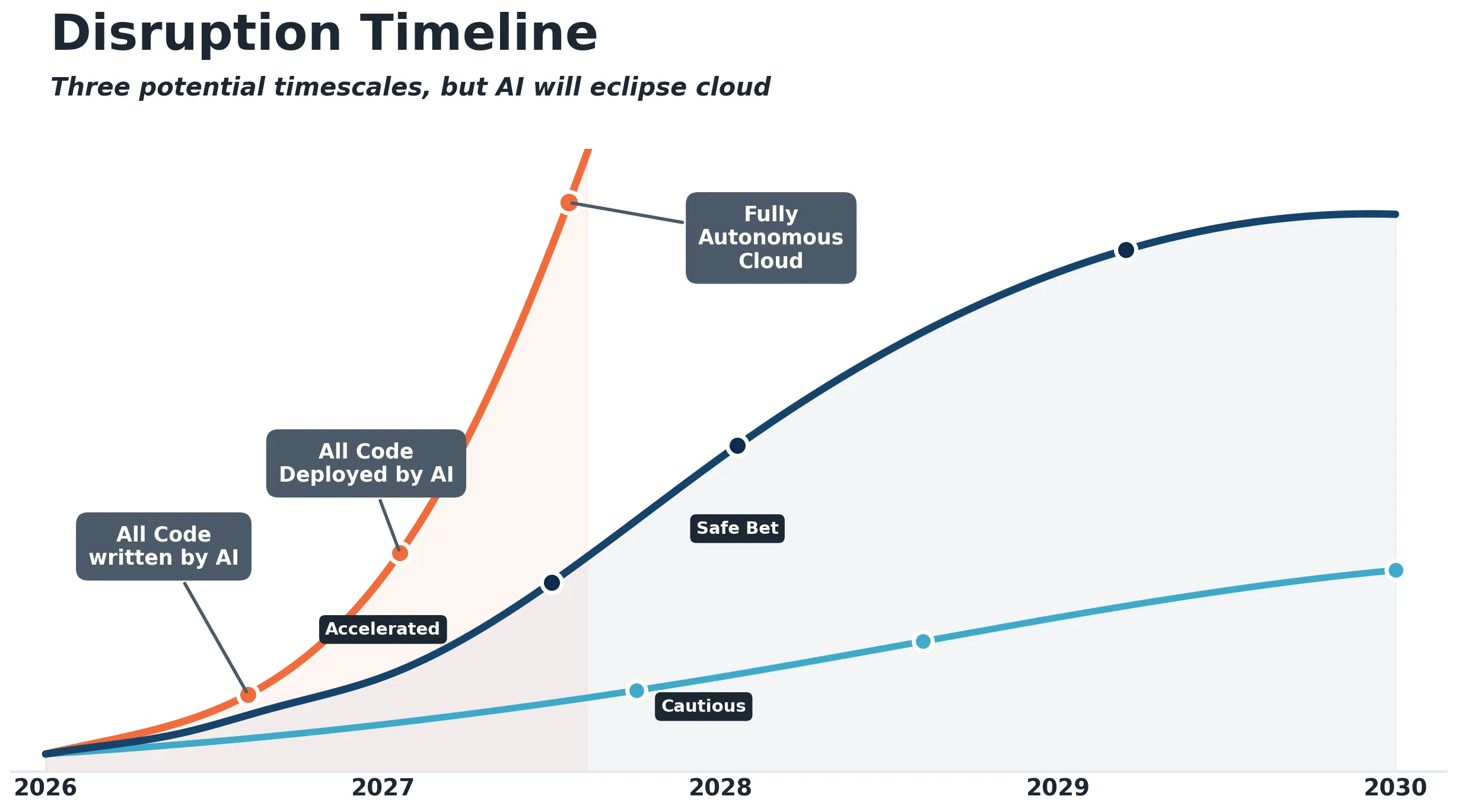
I sketched this out as a disruption timeline, and the shape of it matters more than the exact dates. There are three milestones on the path:
-
All code written by AI. We’re effectively here. By early 2026, roughly 41% of all code is AI-generated, and the share is climbing past 50% on a steepening curve (Netcorp). Anthropic’s Dario Amodei called 90%+ within a year and “nearly all” shortly after (LinkedIn). Whatever your exact number, writing is no longer the frontier.
-
All code deployed by AI. This is the next domino, and it’s already falling. Gartner projects 40% of enterprise applications will include task-specific AI agents in 2026, up from less than 5% in 2025, and over 57% of enterprises already run agents in production (Symphony Solutions). Google is now openly demoing platforms that “run platforms autonomously” and use agents to model and operate systems at scale (Google Cloud Next 2026). The pipeline is the next thing to fall, not the last.
-
Fully autonomous cloud. Write, deploy, operate, and buy — closed loop, no human in the critical path.
The interesting question isn’t whether we reach milestone three. It’s how fast. I see three scenarios — and I’ll tell you up front where my bet sits:
- Cautious: Governance, regulation, and enterprise risk-aversion keep humans firmly in the approval loop. We get autonomous writing and partial deploying, but procurement and operations stay gated. Full autonomy slips toward 2030 and beyond.
- Safe Bet: The comfortable center of gravity. All code written and deployed by AI by 2027–2028, with the fully autonomous cloud arriving around 2029. Agents earn trust incrementally — first in low-risk domains, then everywhere.
- Accelerated — this is my bet. The capability curve outruns the governance curve. If the models keep compounding at their current rate, every milestone pulls a year or more to the left, and the fully autonomous cloud is a 2028 reality. I don’t think the safe-bet line gives the curve enough credit — the steepening we’ve already seen in code generation is exactly what the accelerated case looks like in its early innings.
The future will be unevenly distributed
William Gibson’s line has never been more apt: the future is already here, it’s just not evenly distributed. Here’s the nuance that gets lost when people argue about a single date: there isn’t one timeline. There are three, and they run simultaneously — not just across the market, but inside individual companies.
Most businesses will pick a lane. The disruptable many — startups, digital-native firms, anyone without decades of legacy weight — will follow the accelerated path, because they have nothing to unwind and everything to gain. They’ll close the loop fast and let the autonomous cloud carry them.
The largest companies are where it gets interesting — and dangerous. The biggest enterprises won’t experience one timeline. They’ll experience all three at once. A skunkworks team or a newly-acquired unit races down the accelerated curve. The core platform org plays the safe-bet middle, earning agent trust incrementally. And the crown-jewel legacy systems — the ones that actually generate the revenue — stay pinned to the cautious line by risk, compliance, and organizational antibodies. Three speeds, one company, all running concurrently.
That internal divergence is not a stable state. It resolves one of two ways. Either the accelerated pockets grow until they cannibalize the company from within — the new autonomous core eats the old human-operated business before a competitor does, which is painful but survivable. Or the organization fails to complete the transition: the cautious core holds the company back just long enough for the gap between what it can do and what the market now expects to become unbridgeable. And because these curves are exponential, that gap doesn’t widen gradually — it stays invisible right up until it isn’t. The result is sudden, catastrophic disruption: a company that looked fine on the cautious line one quarter and is structurally obsolete the next.
The uncomfortable truth is that for the incumbents, self-cannibalization is the good outcome. The alternative isn’t a slow decline you can manage — it’s a cliff you don’t see coming.
Here’s the part that should reframe the whole conversation: AI will eclipse cloud, not the other way around. Cloud spend is still rocketing — the infrastructure market is on track to fly past $500 billion in 2026 at 35% growth (Statista). But that growth curve is the cautious line on my chart. The AI capability curve is the steep one. It starts below cloud and crosses over it. The cloud becomes the substrate; the autonomous system becomes the thing that matters.
What it means for the future of cloud
For the cloud industry, the autonomous cloud is an extinction-level event for any company whose value proposition assumes a human operator.
Think about who gets disrupted. A huge fraction of the cloud ecosystem — dashboards, consoles, “single pane of glass” tools, ticketing, runbooks, optimization recommendations — exists to help a person make a decision. When the decision-maker is an agent, the human-facing interface isn’t an asset; it’s dead weight. Agents don’t read dashboards. They don’t file tickets. They don’t wait for the Monday architecture review.
The providers that win won’t be the ones with the prettiest console. They’ll be the ones whose infrastructure is most legible and controllable to machines — clean APIs, machine-negotiable pricing, programmatic governance, and the guardrails an autonomous buyer needs to act safely. The cloud stops being a product you log into and becomes a market that agents transact in.
And the buyer changes. Today, a human signs the committed-use discount and the enterprise agreement. Tomorrow, an agent evaluates spot vs. reserved vs. on-demand across three providers and two model vendors, in milliseconds, against a cost-and-outcome objective. The entire commercial model of cloud — built around human procurement cycles — has to be rebuilt for a buyer that never sleeps and never overpays out of inertia.
What it means for AI
For AI, the autonomous cloud is the moment AI stops being a workload running on infrastructure and becomes the thing operating the infrastructure. The model isn’t a tenant anymore. It’s the landlord.
This is also where the economics get genuinely hard — and genuinely interesting. When a human provisions a server, you can trace the cost to a decision and a budget. When an autonomous system spins up agents, calls models, forks experiments, and procures compute on its own initiative, the spend becomes emergent. It’s generated by the system’s behavior, not by a human’s purchase order. You can wake up to a bill that no single person authorized, because no single person authorized anything — the system did.
That’s why I think the entire discipline has to move from cloud-cost management to value economics: tracing every autonomously-spent dollar to an outcome across the full software lifecycle. “What did this cost?” is a human-operator question. “Was this worth it?” is the only question that survives in an autonomous world, because it’s the only objective you can actually hand to an agent.
What it means for computing
Zoom all the way out and the autonomous cloud is the end of a fifty-year assumption: that computers do what we tell them, when we tell them. We’re moving from computing as instruction to computing as intention. You don’t tell the system the steps. You give it an objective and a budget, and it figures out — and pays for — the rest.
I’ve been living in this future on a small scale. My own research system runs autonomously while I sleep, spinning up agents to solve hard architecture problems, verifying its own work, improving its own loop night after night. The first time you wake up to a solved problem you didn’t touch — and a compute bill the system decided was worth incurring — you understand viscerally that the relationship has inverted. You’re not operating the computer. You’re governing it.
That’s the real shift. The job of the human in the autonomous cloud isn’t operation. It’s governance, intention, and accountability. Setting objectives. Defining guardrails. Deciding what “worth it” means. Owning the outcomes a system produces on your behalf. That’s not a smaller job. It’s a more consequential one — and it’s the only part of the loop that should stay human.
The takeaway
The fully autonomous cloud is coming, and the only real debate is the slope of the line. My bet is the accelerated line: all code written and deployed by AI within the next couple of years, and a genuinely autonomous cloud — one that writes, deploys, operates, and buys without us — arriving as soon as 2028. The safe-bet case buys you maybe a year more. None of the realistic cases are “never,” and planning for the slow one is how you get caught flat-footed.
If you build cloud products, the question is whether your value survives the disappearance of the human operator. If you run cloud spend, the question is whether you can govern a buyer that isn’t a person. And if you build software at all, the question is whether you’re ready to move from operating computers to governing them.
The “and” in “AI and cloud” is already dissolving. What’s left on the other side is just the autonomous cloud. The companies — and the people — who internalize that first are the ones who get to write the rules for everyone else.
The trendlines above draw on AI-generated code share data from Netcorp, enterprise agent-adoption projections from Symphony Solutions and Google Cloud, cloud infrastructure market figures from Statista, and autonomous-operations demos from Google Cloud Next 2026.