 ← Index
Here’s a claim that sounds too small to matter: if your engineers can see the real cost of their decisions while they’re deciding, your costs go down. A lot. Nobody has to tell them what to fix. Nobody has to hand them an optimization playbook. Nobody has to run a savings initiative with a steering committee and a codename. They just have to know.
That’s it. That’s the whole mechanism. And almost nobody believes it until they’ve lived it.
The conventional wisdom
Every cost program I’ve watched fail followed the same blueprint. Diagnose centrally. Prescribe centrally. Distribute tickets. A platform team or a finance analyst studies the bill, produces a ranked list of optimizations — rightsize these instances, delete those volumes, renegotiate that commitment — and routes work to the teams who own the resources. The assumption underneath is so common it’s invisible: engineers won’t manage cost unless they’re told what to do, what to change, and how to change it.
The blueprint fails slowly and politely. The tickets age. The teams comply eventually, resentfully, minimally. Next quarter the bill grows somewhere else, because the people generating the cost still can’t see it, and the people who can see it still can’t generate the fix. You’ve built a loop with the Observe function in one org and the Act function in another, connected by a ticket queue. Boyd would have laughed.
What actually happens
Now run the other experiment. Give a team real-time visibility into what their systems cost — their services, their features, their deploys, denominated in dollars and in unit terms they recognize — and tell them nothing else. No targets. No mandates. No list.
I’ve watched this experiment run for years, and the same thing happens every time. First comes disbelief: that query costs what? Then the quiet fixes start appearing in sprints nobody asked to prioritize. An engineer sees a $30,000-a-month line item behind a feature nobody uses and kills it on a Tuesday. Another notices the dev environment costs more overnight than production does under load and asks a question nobody had thought to ask. The number does the telling. The team does the finding.
The results routinely embarrass the ticket-driven programs. And the reason is the part conventional wisdom can’t digest: the engineer who wrote the system knows a hundred things about it that no central analyst will ever know. Which cache is load-bearing. Which batch job is vestigial. Which architecture was a deadline compromise everyone meant to revisit. A prescription from outside can only target what’s visible from outside. Knowing hands the problem to the people holding the context — and gives them creative license to solve it in ways nobody upstairs could have specified. Prescription gets you compliance. Knowing gets you invention.
Why this was so hard to prove
For years this was the awkward part of the pitch. The mechanism is invisible. There’s no initiative to point at, no savings-program Gantt chart, no before-and-after slide with a consultant’s logo. Cost just starts bending down, one unprescribed decision at a time, and when the CFO asks what did it, the honest answer — “the engineers could see” — sounds like nothing. Belief required living it. The people who ran the experiment became lifers; the people who hadn’t kept asking where the recommendations engine was.
I lived it before CloudZero existed. Fifteen-plus years ago, on one of my first large-scale cloud projects, cost landed on my desk as a nonfunctional requirement — a budget the architecture had to hit, with nobody telling me how. Just knowing the constraint changed every design decision I made that year. It changed my career, for that matter. The conviction that came out of it: every engineering decision is a buying decision, and the buyer deserves to see the price.
The loop explains it
I’ve spent recent essays arguing that orientation is the part of the loop that wins fights, and this is that argument wearing work clothes. Observe, Orient, Decide, Act. A cost report that arrives thirty days after the decision enters nobody’s loop; it’s archaeology. A cost signal that arrives while the decision is live lands in Orient — it joins the engineer’s internal model of the system, right next to latency budgets and failure modes, and starts steering choices the way those do.
And here’s why telling can’t compete with knowing. Boyd’s deepest insight was implicit guidance: when orientation is rich enough, the right move becomes obvious without deliberation. You don’t stop and consult a playbook; the playbook is in you. Cost visibility, sustained long enough, produces exactly that. Engineers stop doing “cost optimization” as an activity and start writing cost-aware systems as a reflex, the same way they stopped doing “security reviews” as the only defense and started writing input validation without being asked. A ticket queue can never become a reflex. A number you see every day becomes one in a quarter.
This is also the cheapest cultural transformation you will ever run, because it requires nobody to change what they believe — only what they can see. Nobody has to be persuaded to care, either. Most engineers already do, abstractly, the way everyone cares about things they can’t measure. You’re removing the blindfold and trusting what happens next.
Conventional wisdom says people must be told. Twenty years of watching says people must be shown.
The AI bill makes this urgent again
Everything above was true when the unit was an EC2 instance. It’s about to be tested at a scale and speed that makes the cloud era look leisurely, because the unit is becoming the token and the decision cycle is becoming minutes. An agentic workflow that burns $400 of inference overnight was designed by an engineer who, today, almost certainly cannot see that number. The lesson transfers intact: don’t build the central AI-spend review board. Put the token cost in the loop of the person who wrote the prompt chain, and get out of the way. Your AI bill is already a report on what’s compounding and what’s evaporating — the only question is whether the people who can act on it are allowed to read it.
Every decision is a buying decision
For fifteen years I said that about engineers, and the qualifier was doing real work: every engineering decision is a buying decision. Engineering held the card because engineering provisioned the infrastructure. This year the qualifier died.
Marketing builds the campaign in ChatGPT. Sales builds the deck in Claude. Sales engineering ships the feature they could never get product to prioritize, in Codex, and now you own it. An executive writes a memo with AI to a room of executives who will summarize it with AI — billable at both ends, for a document nobody wrote and nobody read. Your receptionist schedules the offsite with an agent.
Every one of those is a purchase. And look closely at what they are: not new activities. Old ones, re-plumbed through a meter.
Writing an email used to cost fifteen minutes and nothing else. Now it costs about twenty-five cents, because you drafted it with a model and had a second one check the tone. A web search was free — someone paid for it with an ad impression, a bargain the whole industry stopped noticing around 2004; the same question put to a model runs eight cents and the bill is yours. The deck, the landing page, the quarterly plan, the migration script, the competitive teardown, the board narrative: every one of those was time, or free, or already paid for by somebody else. Every one of them now carries a unit price and shows up on an invoice.
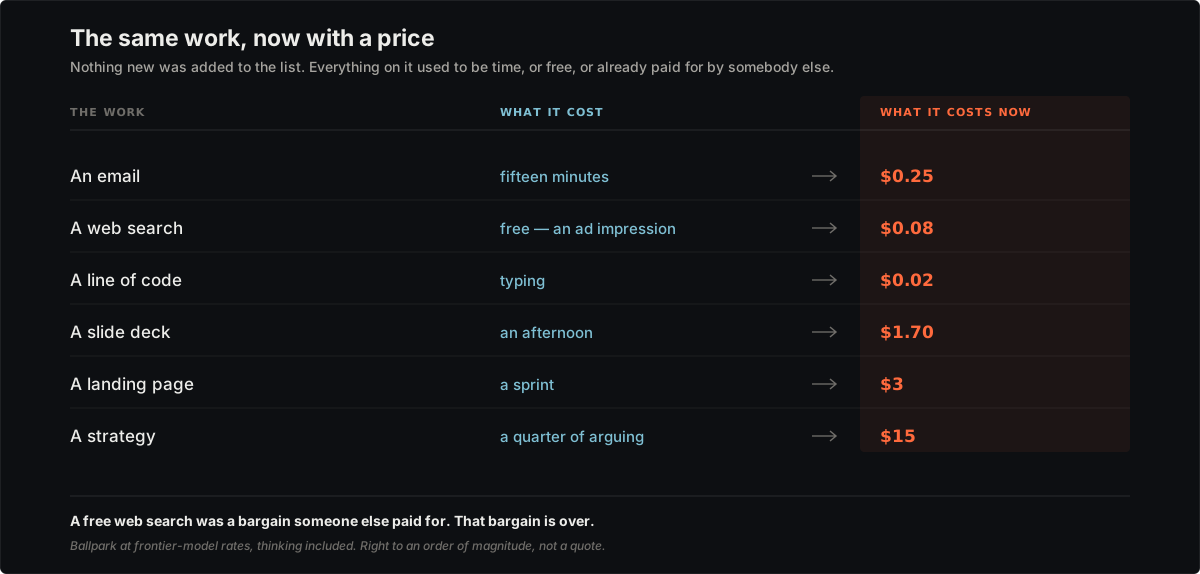
Sit with the scale of that. Every PowerPoint. Every web page. Every line of code. Every strategy. Everything a business has ever done is being rebuilt to be generated, edited, or accelerated by a model — which means the frontier labs have pulled off something no software company ever managed. They found a way to monetize thought itself.
Twenty-five cents isn’t the problem. The problem is that nobody has any muscle memory for this. Engineers took most of a decade to build instincts for cloud spend, and only got there because the bill eventually became a problem they couldn’t ignore. We are now asking every function in the company to build those instincts from scratch, at the same time, while the unit price of a decision changes monthly.
We have seen this before, from one direction. In the early cloud years engineers were told, in effect, that the cloud was free: provision what you need, someone reconciles it later. It took years and some genuinely ugly quarters to unlearn. What differs now is scope. It isn’t a few hundred engineers with an unlimited expense account — it’s everyone. Every person in your company holds one, and not one of them can see the price of what they’re about to buy.
And the blindness is already measured. Enterprises report allocating 30–36% of their cloud budgets to AI while the AI spend they can actually trace on their bills sits closer to 2.5%. Note when that gap was measured: while AI spend still lived mostly inside engineering, among the one population that has spent a decade learning to read a cloud bill. Now hand the same instrument-free environment to marketing, to sales, to legal, to the exec team.
That turns everything above from a pleasing result about engineering culture into a condition of solvency. Knowing what you spend used to be useful. Then it was important. Now it separates the companies that can steer from the companies that find out in arrears.
And the old mechanisms won’t carry it. A monthly bill reviewed by finance was already inadequate for a thousand engineers; it is meaningless for ten thousand people making priced decisions every few minutes. Attribution has to reach past infrastructure and into workflows, and the number has to arrive where the decision is actually made — in the marketer’s tool, the seller’s deck, the analyst’s notebook — not in a dashboard somebody opens on the fifth of the month.
Which is the answer this essay already gave, pointed at everyone instead of at engineering. Put the number where the decision is. Then get out of the way.
Fifteen years ago I learned that every engineering decision is a buying decision. I was wrong by one word.
Every decision is a buying decision. Everyone in your company is a buyer now, spending on your behalf, thousands of times a day, blind.
Which changes what the title of this essay means. For twenty years it was a promise: you don’t need mandates or playbooks or a savings program with a codename, because people who can see the price will do the rest. It still is. But it has become a warning as well — this is the part you don’t get to skip. Not this year. Companies won’t fail because they bought too much intelligence. They’ll fail because they never learned what it cost them, and by the time the invoice explained it, the quarter was gone.
Knowing is enough.